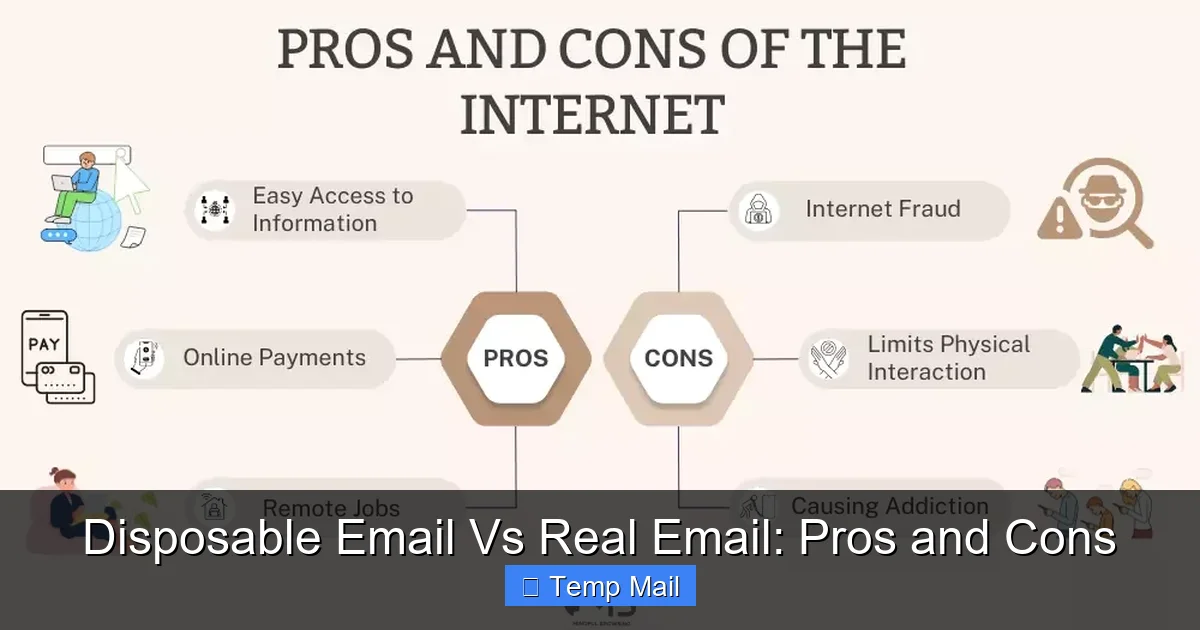
Choosing between a disposable email and a real email address is a critical digital decision. Disposable emails offer instant, anonymous sign-ups to combat spam but lack permanence and trust. Real emails provide identity, security, and long-term communication but expose you to marketing and data risks. The right choice depends entirely on the specific online activity—use temp mail for one-time trials and throwaway sign-ups, and reserve your real email for banking, important services, and professional correspondence.
Key Takeaways
- Disposable emails are temporary tools for privacy and spam avoidance, not for important accounts. They self-destruct quickly and cannot be used for password recovery or essential verification.
- Real email addresses are foundational to your digital identity and security. They are required for critical services, provide accountability, and enable reliable long-term communication.
- Using the wrong type of email for a task creates immediate problems. A disposable email for a bank account means losing access forever; a real email for a shady forum floods your inbox with spam.
- Many websites actively block known disposable email domains. This is a major limitation for temp mail users trying to access certain platforms or promotions.
- Security is a double-edged sword. Disposable emails protect your main address from breaches but offer zero protection for the temporary account itself. Real emails, when properly secured with 2FA, are more robust for sensitive data.
- The smartest strategy is often a hybrid approach. Use a dedicated “junk” real email for low-stakes newsletters and a primary real email for everything important, while leveraging disposable emails for truly anonymous, one-off interactions.
📑 Table of Contents
- Introduction: Your Email Address as a Digital Key
- What Exactly is a Disposable (Temp) Email?
- What is a “Real” or Permanent Email Address?
- Pros and Cons: Disposable Email Deep Dive
- Pros and Cons: Real (Permanent) Email Deep Dive
- Security & Privacy Showdown: Which is Safer?
- Practical Use Cases: When to Use Which
- The Hybrid Strategy: The Best of Both Worlds
- Conclusion: Intentionality is Everything
Introduction: Your Email Address as a Digital Key
Think about your email address. It’s not just an inbox; it’s your username, your recovery tool, your digital mailbox, and often, the first key to your online identity. But what if you could have a different key for every door? That’s the promise of disposable email. The choice between using a disposable, temporary address versus your permanent, real email is one of the most frequent—and most impactful—decisions we make online every single day. It’s a battle between convenience and security, anonymity and accountability, short-term gain and long-term risk. This article will dissect both sides, giving you a clear framework to decide exactly which tool to use, and when.
What Exactly is a Disposable (Temp) Email?
A disposable email address is a temporary, anonymous inbox created from a public provider like Temp-Mail, 10MinuteMail, or Guerrilla Mail. You visit their site, they generate a random address (e.g., [email protected]), and you use it to sign up for a website or receive a single file. The inbox is usually accessible via a web page without a password, and it automatically deletes everything—the address and all messages—after a set time, often 10 minutes to a few hours.
Visual guide about Disposable Email Vs Real Email: Pros and Cons
Image source: smartsheet.com
The Core Mechanics: How They Work
These services operate on a simple principle: they maintain a pool of domains and generate unique inboxes on the fly. When an email is sent to that address, it’s stored on their server, and you view it through a public web interface. There’s no login, no persistent account, and no personal data tied to the creation of the inbox. This makes them incredibly fast and requires zero commitment.
What is a “Real” or Permanent Email Address?
A real email address is a permanent account you create with a provider like Gmail, Outlook, Yahoo, or your own custom domain (e.g., [email protected]). It requires registration with personal information (name, sometimes a phone number), a password, and often two-factor authentication (2FA). It is designed for long-term use, with storage, organizational tools (folders, labels), and robust security features. It is intrinsically linked to your identity, either personally or professionally.
Visual guide about Disposable Email Vs Real Email: Pros and Cons
Image source: smartsheet.com
The Pillars of a Real Email: Security & Identity
The value of a real email lies in its stability and its role as a verified identity anchor. Major services—from social media to banking to government portals—rely on it to confirm “you are you.” It’s the primary channel for password resets, security alerts, official statements, and meaningful correspondence. Losing access to it is a major crisis.
Pros and Cons: Disposable Email Deep Dive
Let’s break down the temp mail argument. Its strengths are sharp and specific, but its weaknesses are absolute.
Visual guide about Disposable Email Vs Real Email: Pros and Cons
Image source: nonprofithub.org
Pros: The Shield Against Spam and Tracking
The primary, overwhelming advantage is spam prevention. Use a disposable address for that sketchy free ebook download or a forum you’ll never visit again. The promotional emails and potential data breaches are confined to an inbox that will vanish. It’s a perfect privacy tool for one-off interactions where you don’t want to hand over your primary contact. It also offers instant access—no sign-up forms, no verification emails to click, just copy, paste, and get your download link immediately.
Cons: The Ephemeral Nature and Trust Deficit
The biggest con is also its defining feature: impermanence. If you need to recover a password or receive a receipt later, you are out of luck. The inbox is gone. This leads to a severe lack of trust. Most legitimate businesses, especially in finance, e-commerce, or SaaS, block disposable email domains at the registration gate. They see them as high-risk for fraud and abuse. You also have zero security—anyone with the public URL can read your temporary inbox. There is no encryption, no 2FA, no privacy.
Pros and Cons: Real (Permanent) Email Deep Dive
Your everyday email is the workhorse of the digital world, but it comes with its own set of trade-offs.
Pros: The Bedrock of Security and Access
Reliability and Access are paramount. Your bank, your employer, your doctor—they all need to reach you reliably. A real email provides a persistent, recoverable channel. When paired with strong security features (encryption, 2FA, suspicious login alerts), it becomes a secure hub for sensitive information. It builds trust and credibility; using a professional address in correspondence signals seriousness. Finally, it offers full functionality: rich storage, search, calendars, contacts, and integration with countless apps.
Cons: The Spam Magnet and Data Footprint
The flip side of being a trusted identity is being a target. Your real email is a magnet for spam and phishing attempts. Every data breach that includes email addresses puts you at risk. It creates a persistent digital footprint; every online account you create with it is a data point linked to your identity, which can be sold, scraped, or leaked. Managing this requires constant vigilance—unsubscribing, using spam filters, and employing unique passwords.
Security & Privacy Showdown: Which is Safer?
This is the most nuanced comparison. “Safer” depends entirely on the threat model.
Disposable Email for Data Breach Avoidance
If the threat is your email address being exposed in a company data breach and then used for credential stuffing attacks on your other accounts, a disposable email is safer for that specific sign-up. The breached data contains a dead-end address. Your primary inbox remains clean and separate.
Real Email for Account Security & Recovery
If the threat is losing access to an important account (social media, cloud storage, financial), a real email is infinitely safer. It’s the only reliable way to recover an account. Disposable emails provide zero recovery path. Furthermore, for services with high security (like password managers or crypto exchanges), using a disposable email is not an option; they require a verified, persistent contact method.
The Verdict: Layered Security
The safest approach is layered. Use a dedicated, real “junk” email address (separate from your primary) for newsletters, retail sites, and forums. This contains spam and breach exposure. Use a disposable email only for truly anonymous, low-value, one-time interactions where no account recovery is ever needed. Your primary, most secure real email should be locked down with a unique, strong password and 2FA, used only for critical services.
Practical Use Cases: When to Use Which
Let’s get concrete. Here is a simple guide for everyday decisions.
- USE DISPOSABLE EMAIL FOR:
- Downloading a free ebook, template, or whitepaper from a lead gen site.
- Signing up for a contest or free trial you have no intention of continuing.
- Accessing a gated article or video where you just need the link.
- Creating an account on a forum or comment section you’ll use once.
- Testing a website’s email functionality as a developer.
- USE A REAL EMAIL FOR:
- Anything financial: Banking, PayPal, investing apps, credit cards.
- Official & Legal: Government services (IRS, DMV), legal documents, university portals.
- Primary Cloud & Tech: Google, Apple, Microsoft, Amazon accounts. These are master accounts.
- Professional Communication: LinkedIn, job applications, client emails.
- Healthcare: Patient portals, doctor communication.
- Password Recovery: Any service where you might need to reset your password.
- Long-term Subscriptions: Netflix, Spotify, software subscriptions you pay for.
The Hybrid Strategy: The Best of Both Worlds
Most savvy internet users don’t choose one or the other exclusively. They employ a tiered system.
Tier 1: The Primary Real Email
This is your crown jewel. Use it for your most important accounts: email provider itself, password manager, primary phone account, banking. Protect it with a unique, strong password and 2FA. Never use it for casual sign-ups.
Tier 2: The Secondary/Junk Real Email
Create a second free email address (e.g., a new Gmail). Use this for online shopping newsletters, retail sites, hobby forums, and non-critical apps. This contains the spam and marketing blasts. You can check it occasionally or set up filters. If this address gets spammed to oblivion, you can abandon it without catastrophic loss.
Tier 3: The Disposable Email
Keep a disposable email tab open for the random web form that asks for an email but whose value you immediately question. Use it and forget it. This is your first and last line of defense against unwanted attention.
Conclusion: Intentionality is Everything
The disposable email vs. real email debate isn’t about which is universally “better.” It’s about using the right tool for the job. A disposable email is a fantastic, anonymous shield for the low-stakes, one-time corners of the internet. It’s a privacy hack for the modern web. Your real email, however, is the cornerstone of your secure, functional, and recoverable digital life. It is non-negotiable for anything that matters. The most powerful approach is mindful, intentional use: default to your disposable for the unknown, use your secondary real email for the casual, and guard your primary real email with your digital life. By understanding the profound pros and severe cons of each, you take control of your inbox, your privacy, and your online security.
Frequently Asked Questions
Are disposable emails legal to use?
Yes, creating and using a disposable email address is completely legal. The service providers operate within the law. The legality issues arise from how the address is used (e.g., for fraud, harassment, or bypassing bans), not from the act of having a temporary inbox itself.
Can websites detect and block disposable emails?
Absolutely. Most reputable websites and services use databases of known disposable email domains (like those from Temp-Mail or 10MinuteMail) and automatically block sign-ups from those addresses. This is a primary reason you’ll often see an error message like “Please use a valid email address” when trying to use a temp mail for an important service.
Is it safe to use a disposable email for password resets?
No, it is not safe. Using a disposable email for any account where you might need to recover your password is a guaranteed way to permanently lose access to that account. Once the disposable inbox expires, the password reset email is gone forever, and you cannot log in.
What happens to the emails sent to a disposable address?
Emails sent to a disposable address are stored on the temporary service provider’s server for the short lifespan of the inbox (e.g., 10 minutes, 1 hour, 1 day). After that time, both the inbox and all contained emails are automatically and permanently deleted from their systems.
Should I use a disposable email for social media accounts?
It depends. For anonymous, throwaway accounts on platforms like Reddit or Twitter where you don’t care about the account, it might be okay. However, for any social media you intend to use long-term, connect with friends, or use for professional networking, you must use a real, accessible email. You will need it for password recovery, and many platforms may flag or restrict accounts with disposable emails.
Can disposable emails be traced back to me?
Generally, no. The disposable inbox itself is not tied to your personal identity. However, your activity is not completely anonymous. Your IP address is logged by the disposable email service provider when you visit their site. More importantly, any personal information you voluntarily include in the emails you send from that disposable address (like your name in the signature) can obviously identify you. The anonymity is about the inbox’s link to your identity, not your general web activity.
Leave a Reply